Category: Uncategorized

  • Glassine for Archival Storage: Protecting Photos, Art, and Collectibles

    Glassine for Archival Storage: Protecting Photos, Art, and Collectibles

    Glassine spends most of its life as bakery and boutique packaging, but it has a second career that predates the gift shop: protecting things people cannot afford to damage. Photographers, artists, framers, stamp and print collectors, and museum staff all reach for glassine to interleave, wrap, and shield delicate materials. If you are considering glassine bags or sheets for archival use, it helps to know exactly why conservators like it, the specific jobs it does well, and the honest limits that separate it from true permanent storage materials. Used for the right task, glassine is inexpensive and excellent. Used for the wrong one, it creates a false sense of security.

    Why archivists reach for glassine

    Glassine’s value in storage comes from a short list of physical traits. It is smooth and non-abrasive, so it will not scuff a photograph’s emulsion or scrape a graphite or pastel surface, and because it is dense and hard-surfaced it resists offsetting, the transfer of media onto the interleaving sheet. It is typically acid-free and pH neutral, usually measuring right around 7.0, which means it will not drive the yellowing and embrittlement that acidic papers cause in whatever they touch. It is grease- and moisture-resistant at the surface, useful for interleaving oil-based media or protecting against fingerprints and light spills. And it is translucent, letting you identify what is inside a wrapper or sleeve without unwrapping it. The profile below shows where those strengths sit, and where the one real weakness is.
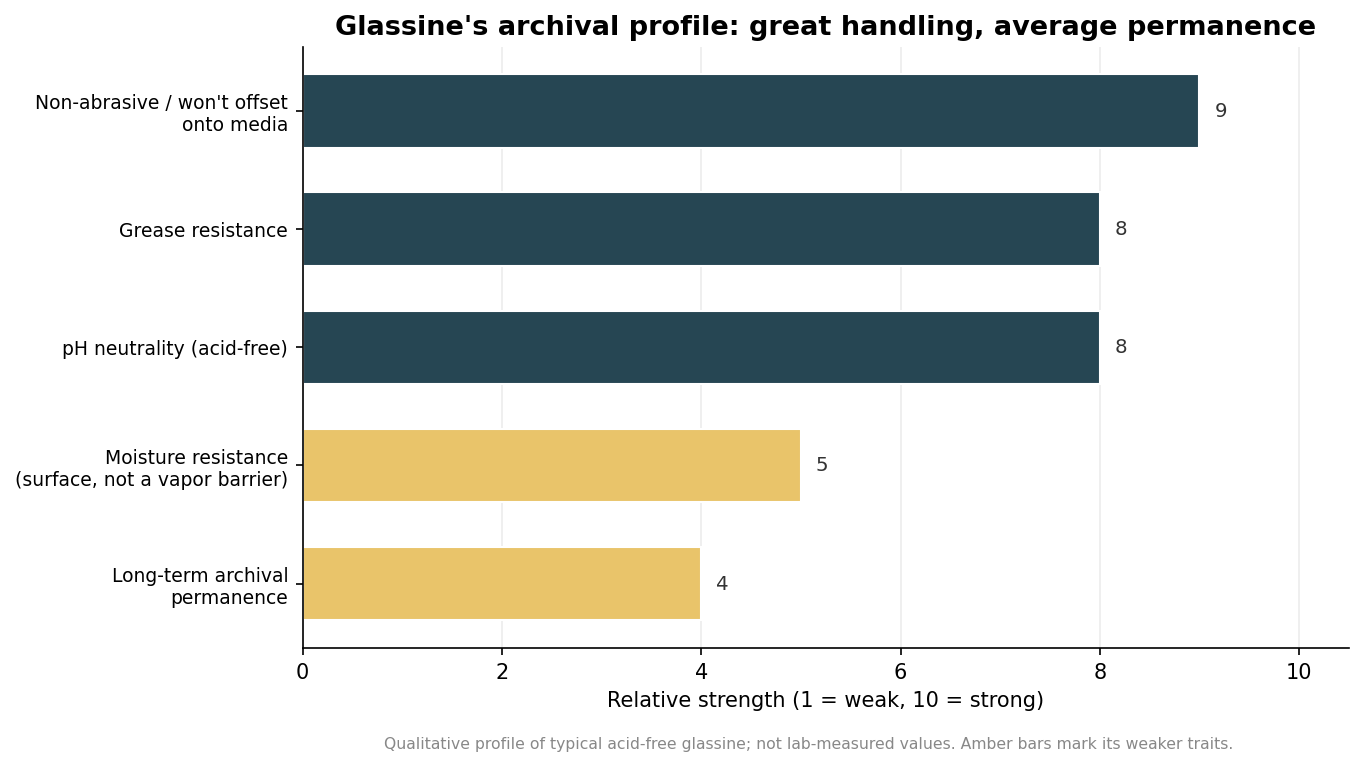
    Horizontal bar chart profiling glassine on non-abrasiveness, grease resistance, pH neutrality, moisture resistance, and long-term permanence
    Glassine excels at gentle handling and short-term protection; permanence is its weak point.

    The takeaway from that profile is that glassine is outstanding at handling and short-term protection and only average at permanence. That is not a flaw so much as a definition of what the material is for, and it maps cleanly onto which jobs it should and should not do.

    The jobs glassine does best

    Interleaving artwork is glassine’s signature use. Slipping a sheet between stacked prints, watercolors, pastels, and charcoal drawings keeps surfaces from rubbing against one another in a portfolio or flat file, and its non-offsetting surface makes it safer for friable media than many alternatives. Protecting photographs is a close second; unbuffered neutral glassine is a common choice for interleaving prints and negatives because it is smooth and chemically calm against emulsions. Stamps, coins, pressed botanicals, and paper ephemera have been stored in glassine envelopes for generations, and it remains the default in philately for exactly that reason. And for shipping and short-term transit, wrapping a framed piece or an original print in glassine adds a clean grease- and scuff-resistant layer that costs little and adds almost no weight. In all of these, glassine is doing the job of a gentle, chemically safe buffer for weeks, months, or a few years.

    What glassine is not

    Being honest about the limits is what keeps a collection safe. First, glassine is not a moisture or vapor barrier. It resists surface grease and brief contact with liquid, but it will absorb ambient humidity, and in damp conditions it can cockle, and in extreme cases stick to whatever it wraps, so it is no substitute for climate control. Second, glassine is not a permanent archival material in the way inert polyester film or high-quality buffered board is. Conservation references note that glassine can become acidic and brittle as it ages, which means the neutral pH you start with is not guaranteed to hold across decades. For truly long-term storage of valuable items, conservators favor inert polyester sleeves such as Mylar or Melinex, or acid-free tissue, and often treat glassine as a working, replaceable interleaf rather than a permanent enclosure.

    There is also a nuance worth understanding: buffered versus unbuffered. Buffered papers carry an alkaline reserve that helps neutralize acids over time and are generally preferred for most paper artifacts, while unbuffered neutral materials are often recommended for photographs and certain color media that can be harmed by alkalinity. Most glassine is unbuffered and neutral, which makes it a natural fit for photographic interleaving but not the automatic best choice for every paper object. The comparison below places glassine against the two materials it is most often weighed against.
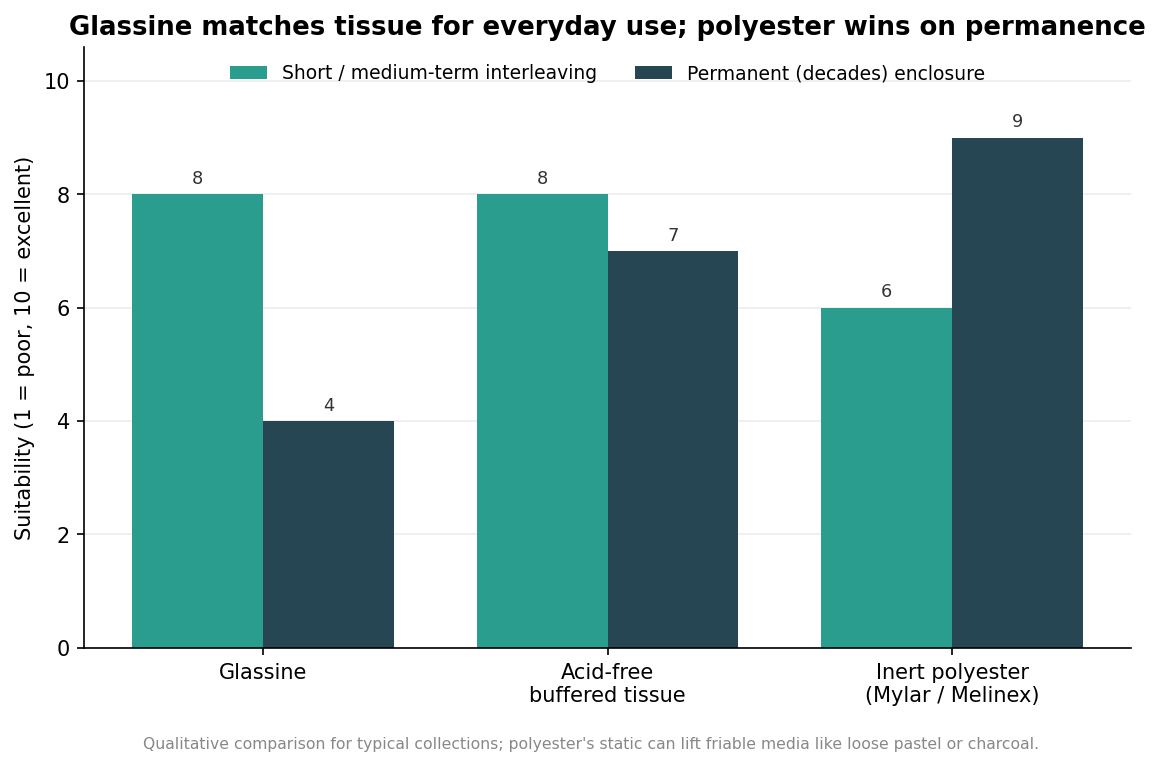
    Grouped bar chart comparing glassine, acid-free buffered tissue, and inert polyester on short-term interleaving and permanent enclosure suitability
    For decades-long storage of valuable pieces, inert polyester outperforms glassine.

    The pattern is clear: glassine and acid-free tissue are both strong for the everyday interleaving that most people actually need, while inert polyester pulls ahead specifically for permanent, decades-long enclosure of high-value pieces. One caution on polyester, though, is that its static charge can lift friable media like loose pastel or charcoal, so it is not a drop-in replacement for glassine in every case. The right material depends on the object and the time horizon, not on which one sounds the most archival.

    How to choose glassine for archival use

    If glassine fits your task, a few specifics make the difference. Confirm the paper is acid-free and neutral pH and, for photographs, that it is unbuffered; a supplier should be able to state both plainly. Choose a weight that matches the handling: lighter glassine around the 25 to 30 gsm range drapes well for interleaving and wrapping, while heavier stock holds up better as a bag or envelope that will be opened and closed repeatedly. Match the format to the workflow, using flat interleaving sheets for portfolios and flat files, and glassine bags or envelopes for small collectible items that need containment. Size the enclosure so the item sits without forcing or excessive slack. If you are printing a logo on glassine bags for a shop, remember that the same smooth, low-absorbency surface that protects artwork also makes ink adhesion trickier, so keep archival-contact designs minimal and confirm the ink is suitable for direct contact with what you store. Chosen with those points in mind, glassine remains one of the most cost-effective protective materials available, provided you use it for the handling and medium-term jobs it was built for and step up to polyester or acid-free tissue when permanence is the priority.
  • Glassine vs. Cellophane, Poly and Greaseproof: A Material Comparison

    Glassine vs. Cellophane, Poly and Greaseproof: A Material Comparison

    Glassine, cellophane, poly, greaseproof, parchment: to a shopper they all look like the thin see-through bag around a cookie or a print. To a buyer specifying packaging, they behave completely differently in three ways that matter, namely how clearly they show the product, how well they hold back grease and moisture, and what happens to them after use. Choosing by habit or by whatever a supplier calls “clear bags” is how brands end up with plastic they meant to avoid or paper that soaks through. This comparison lines the common options up against glassine so you can pick on properties rather than on the label.

    What actually makes glassine glassine

    Glassine starts as ordinary wood-pulp paper and earns its glassy, translucent surface through supercalendering, a finishing step that runs the sheet through heated high-pressure rollers until the fibers are compressed and the internal air gaps that scatter light are squeezed out. That mechanical densification, not a plastic or wax coating, is what gives uncoated glassine its grease resistance and smooth finish. The distinction is the whole story on disposal: because the barrier is structural rather than a coating, uncoated glassine stays a pure paper product that is acid-free, neutral in pH, recyclable in the paper stream, and compostable at home or industrially where the inks and adhesives also qualify. Add a silicone or barrier coating for tougher moisture performance and you generally forfeit both the recyclability and the compostability.

    Glassine versus cellophane, and the plastic in disguise

    This is where buyers get caught. True cellophane is made from regenerated cellulose, a wood- or cotton-derived material that is genuinely biodegradable, but most bags sold today as “cellophane” are not cellophane at all. They are BOPP, a biaxially oriented polypropylene film, which is a crisp, glass-clear plastic that heat-seals beautifully and is excellent at holding moisture out, but is not compostable and behaves like any other plastic at end of life. If sustainability is part of your pitch, never accept “cellophane” as a spec without confirming whether it means regenerated cellulose or BOPP plastic. Glassine sits between them on clarity, offering translucency and partial product visibility rather than the perfect transparency of BOPP, but it keeps the plastic-free, paper-stream disposal that neither poly nor BOPP can match.

    Glassine versus clear poly bags

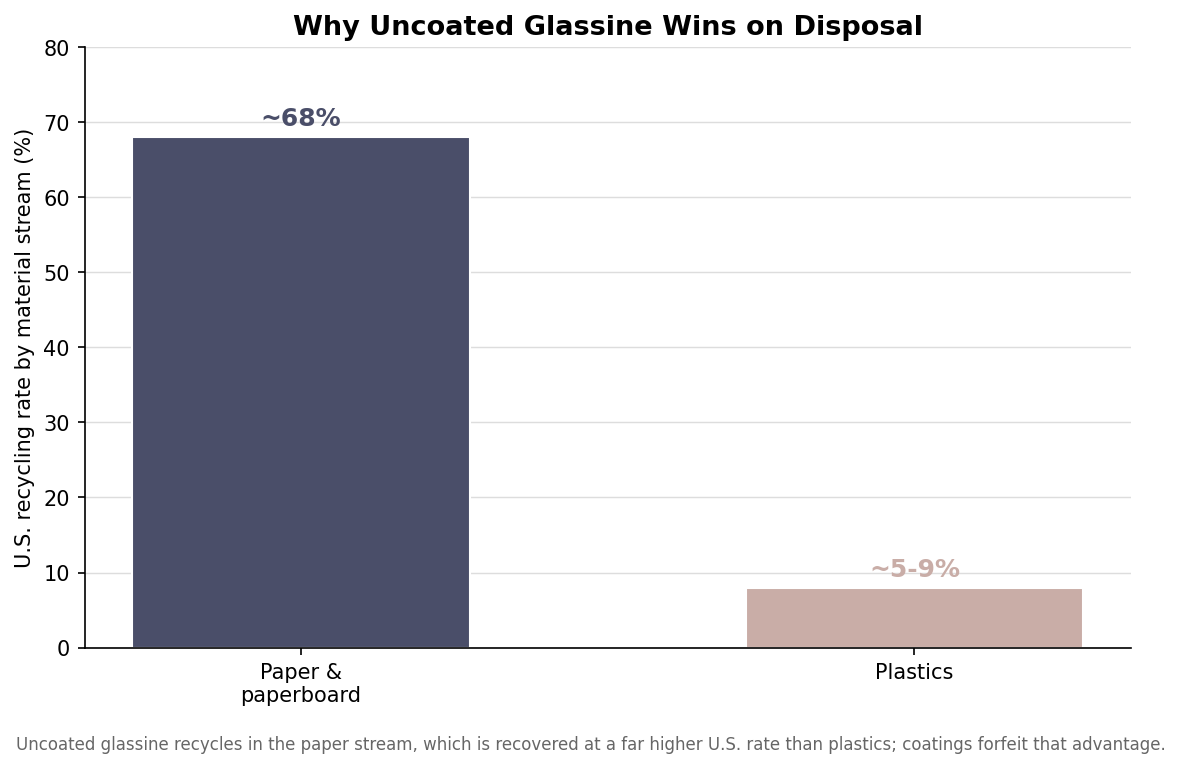
    Clear poly bags, usually low-density polyethylene or polypropylene, win on two counts: total transparency and a genuine heat-sealable, moisture-resistant closure that keeps humidity out for long storage. Where they lose is disposal and story. Thin film plastic is difficult to recycle curbside and typically has to go to a source-separated drop-off, while uncoated glassine rides the ordinary paper stream that the U.S. recovers at a far higher rate.

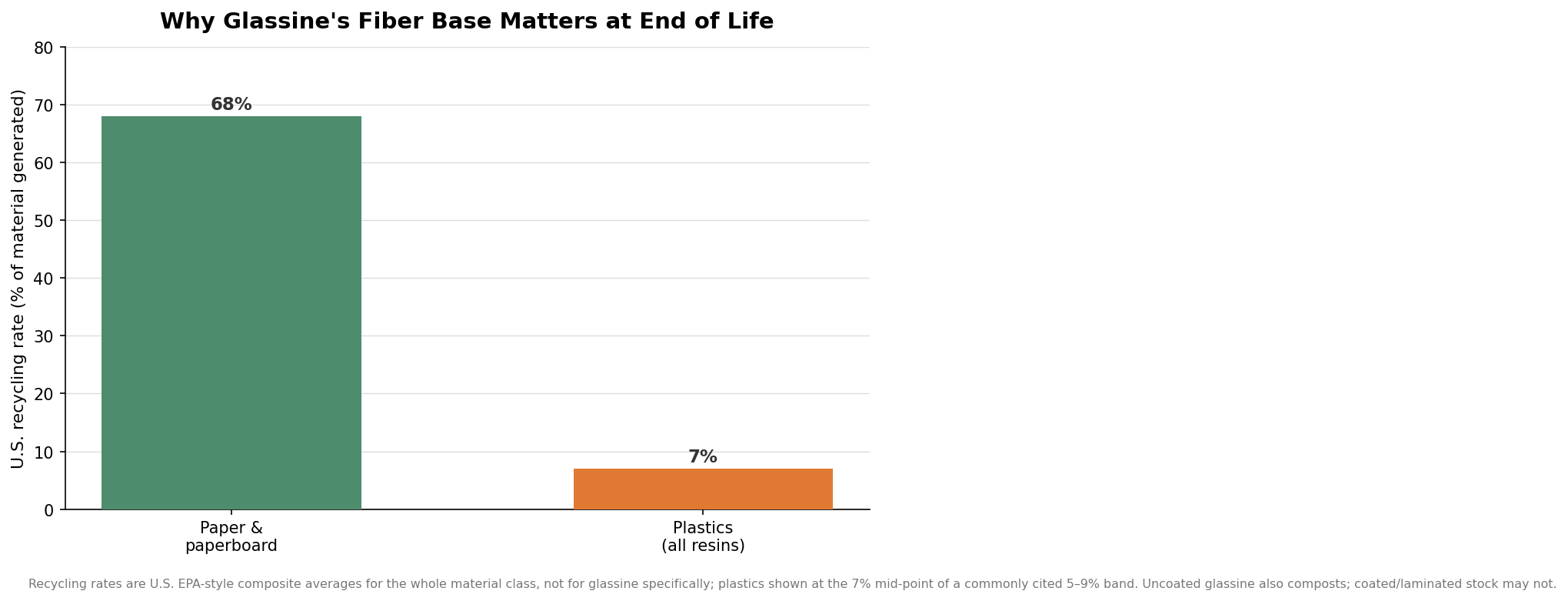
    Bar chart comparing U.S. recycling rate of paper and paperboard around 68 percent versus plastics around five to nine percent
    Uncoated glassine recycles in the paper stream, recovered far more often in the U.S. than plastic film.

    There is an honest counterpoint worth stating: glassine is not automatically the greener choice by every measure. It usually starts from virgin fiber and carries a higher manufacturing carbon footprint than an equivalent thin plastic film, and plastic can be made with recycled content. The reason most boutiques and bakeries still prefer glassine is the combination of a paper look and feel, plastic-free marketing, and a disposal path their customers actually understand, not a claim that it beats plastic on every lifecycle metric.

    Glassine versus greaseproof and parchment

    All three resist grease without a plastic coating, but they are tuned for different jobs. Greaseproof paper is made from the same refined pulp taken further into an ultra-dense sheet, giving it a matte, opaque surface and stronger resistance for genuinely high-fat foods. Parchment adds a treatment that tolerates oven heat, which is why it lines baking trays. Glassine offers only good grease resistance, ample for lightly greasy or dry items such as cookies, chocolates, soap, stamps, and prints, but it is the wrong pick for prolonged contact with very oily food, where greaseproof does better. Glassine’s advantage over both is that glossy, semi-transparent surface that lets the product show through, which is exactly why it reads as premium retail packaging rather than a kitchen liner. None of them is waterproof; glassine slows moisture transfer but will eventually absorb water under prolonged contact, so it is a presentation and short-term protection material, not a submersion barrier.

    Matching weight to the job

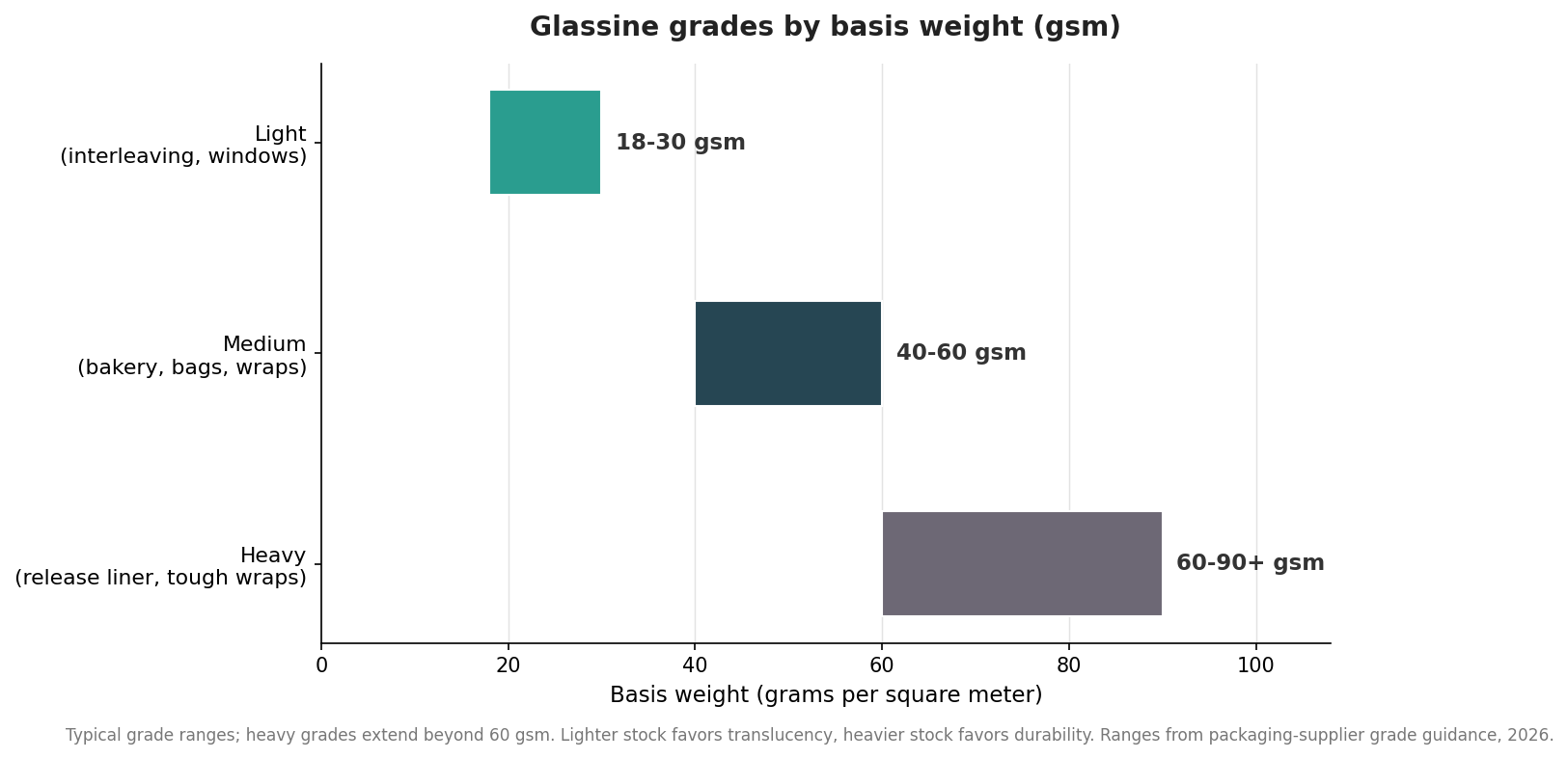
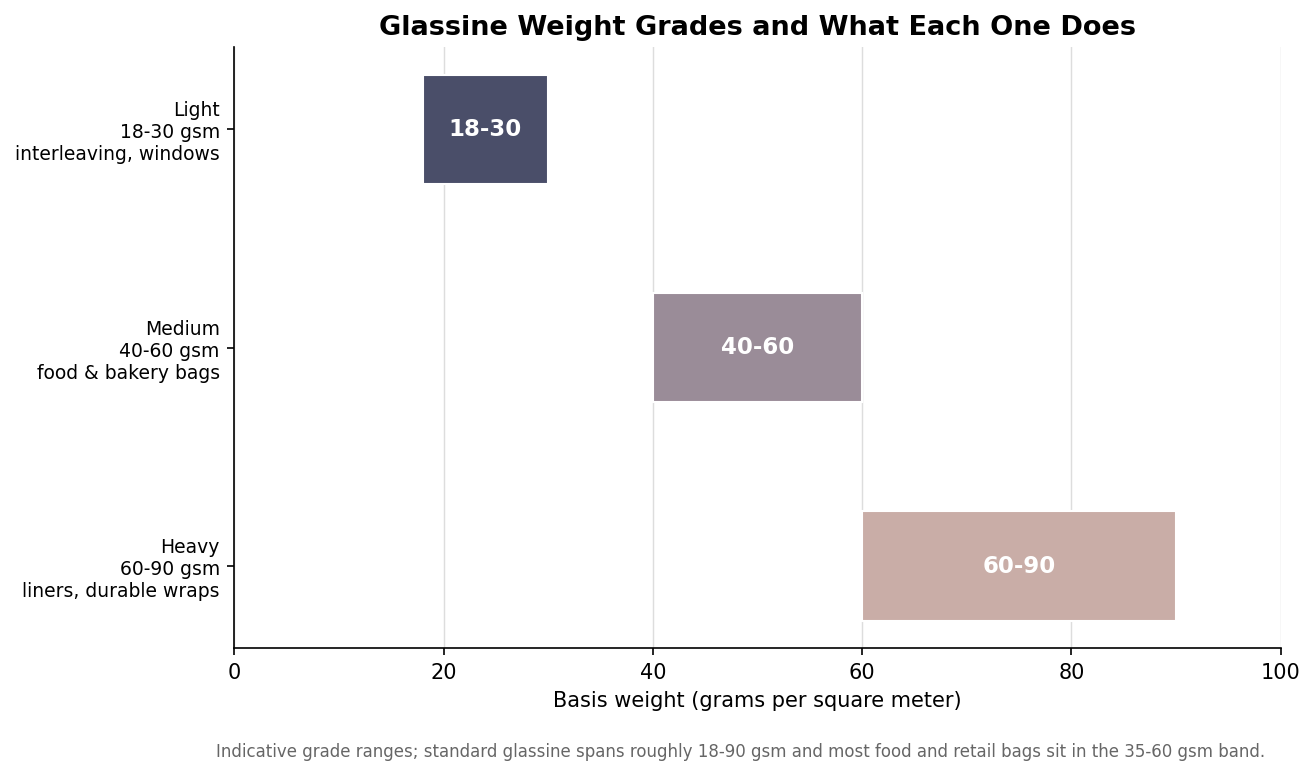
    Once you have chosen glassine, weight is the specification that most affects how the bag performs and feels. Standard glassine runs roughly eighteen to ninety grams per square meter, and the grade you pick should follow the contents. Light stock around eighteen to thirty gsm suits interleaving sheets, envelope windows, and tissue-style wraps where the paper only has to separate or veil. The middle band of roughly forty to sixty gsm is the workhorse for food and retail bags, heavy enough to hold a pastry or a bar of soap and take a clean print. Heavier stock past sixty gsm goes into release-liner bases and durable wraps that need to survive handling.

    Floating bar chart of glassine weight grades in gsm: light 18-30, medium 40-60, heavy 60-90 with typical uses
    Glassine spans roughly 18 to 90 gsm; food and retail bags mostly live in the 35 to 60 gsm band.

    One last practical note on closure: because glassine is paper, it does not heat-seal the way BOPP or poly does, so plan to close it with a fold, a printed sticker, a tab, or an adhesive strip rather than a sealed bar. Decide that early, because it affects both the machine time on a packing line and the look on the shelf. And whatever grade you land on, confirm the specific stock is certified food-grade to the relevant FDA or regional standard before it touches anything edible, since food contact compliance is a property of the certified sheet, not of glassine in general.

  • How to Choose the Right Glassine Bag Weight (GSM Guide)

    How to Choose the Right Glassine Bag Weight (GSM Guide)

    Most glassine buying guides talk about dimensions first. The spec that actually decides whether a bag protects your product is its basis weight — the grams per square meter (gsm) of the paper itself. A bag that is the right size but the wrong weight either wastes money or lets grease bleed through, and there is no way to fix that after the print run. This walkthrough covers how glassine weight is measured, the three weight bands you will actually be quoted, and how to match a grade to what you are packing.

    What “glassine weight” actually measures

    Glassine is a wood-pulp paper that gets its glassy, translucent surface from supercalendering — the dried web is run through heated, high-pressure rollers again and again until the fibers lie flat and the sheet becomes dense and closed. The result is paper that is close to twice as dense as ordinary uncoated stock, often above 1.0 g/cm³, with almost no porosity. That density is what gives glassine its grease resistance without any wax or plastic coating.

    Basis weight is quoted in gsm and, for glassine, commonly runs from about 18 gsm at the lightest to roughly 90 gsm at the heaviest. Two sheets can share the same footprint and feel completely different in the hand because of this number. Higher gsm means a stiffer, more opaque, more protective bag; lower gsm means a lighter, more see-through, more economical one. Everything below is about spending that weight where it earns its keep.

    The three weight bands and what each is for

    Light grades, roughly 18–30 gsm. This is interleaving and window territory. Slip sheets between prints and photographs, tissue-style garment wraps, and the little transparent panels in envelopes all live here. The paper is prized for being thin, smooth, non-abrasive, and static-free rather than for being a heavy barrier.

    Mid grades, roughly 40–60 gsm. This is the workhorse range for food and retail. A sheet around 40 gsm already resists butter and oil migration well enough for pastry interleaving and general food wrapping, which is why bakery liners cluster here. Move toward 50–60 gsm when you want a bag that holds its shape on a shelf and takes a clean print.

    Heavy grades, 60 gsm and up. Once you pass 60 gsm you are into durable merchandise bags and the base stock used for release liners. These feel substantial, block more light, and stand up to repeated handling. You pay for the extra fiber, so reserve this band for products that need the structure.

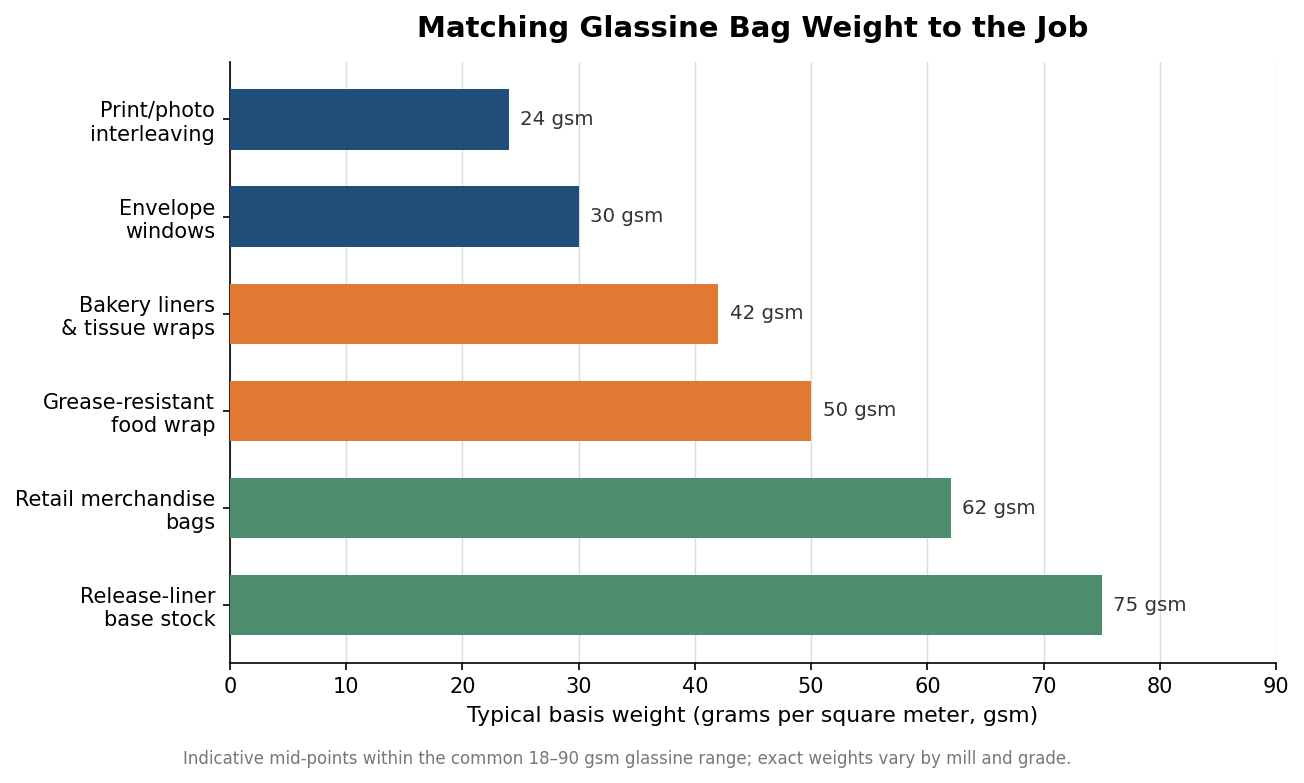
    Horizontal bar chart of typical glassine basis weights in gsm for interleaving, envelope windows, bakery liners, food wrap, retail bags and release-liner stock
    Typical glassine weights by application, within the common 18-90 gsm range.

    What the grease and moisture barrier does — and does not do

    The barrier in glassine is structural, not a coating. Because supercalendering closes the pore network, oils and greases cannot wick through the way they do in ordinary paper, and water-vapor transmission sits well below that of plain uncoated paper of the same weight. For interleaving chocolates, wrapping a scone, or protecting a print from fingerprints, that is exactly the behavior you want.

    It is still paper, though. Glassine slows moisture; it does not stop it. Prolonged contact with liquid water, or full submersion, will eventually soak the sheet. If your product is wet, oily to the point of pooling, or needs a true moisture seal for long-term storage, glassine is the wrong barrier and you should look at a coated or laminated structure instead — accepting that you trade away the clean recyclability described below.

    Food safety and archival use

    Two properties make glassine popular well beyond packaging. First, it is typically acid-free with a neutral pH in the 7–9 range, which is why archivists, photographers, and stamp collectors use it to interleave and store material without the yellowing and embrittlement that acidic papers cause over time. Second, food-grade glassine is made for direct contact with dry and greasy foods.

    If a bag will touch food, ask the supplier specifically for a food-contact-grade sheet and for the documentation behind it, rather than assuming any glassine qualifies. “Glassine” describes how the paper is finished, not a guarantee that a particular roll was manufactured and certified for food use. The distinction matters at reorder time, so get it in writing on the first order.

    End of life: recycling and composting

    The reason many brands move to glassine is what happens after the customer is done with it. Uncoated glassine is fiber and nothing else, so it recycles in the standard curbside paper stream and is both home- and industrially compostable, breaking down naturally rather than persisting. That end-of-life story is only intact while the paper stays uncoated — add a plastic laminate or a non-compostable ink and you can forfeit both the recyclability and the compostability.

    The contrast with plastic film is the selling point worth putting on your packaging copy. Paper and paperboard are recovered in the United States at roughly 68% of what is generated, while plastics as a class sit in the single digits. Those are broad material-class averages rather than glassine-specific figures, but they explain why a fiber-based bag reads as the more responsible choice to a sustainability-minded buyer.

    Bar chart comparing U.S. recycling rates of paper and paperboard versus plastics
    Fiber-based glassine recycles in the paper stream, where recovery rates far exceed those of plastics.

    Specifying it in one line

    Put the weight first. Decide what the bag has to survive — a slip sheet, a greasy pastry, a shelf, a shipping journey — pick the band that matches, then confirm size, window, and print. For anything touching food, add “food-contact grade, documentation required” to the spec, and if you are marketing the eco angle, keep the sheet uncoated and confirm the inks are compost-compatible. Get those points on the quote and the bag will do its job on the first run instead of the third.

  • What Glassine Actually Is – and Where It Fits Your Packaging

    What Glassine Actually Is – and Where It Fits Your Packaging

    Glassine gets specified for its looks: that smooth, semi-transparent sheet that makes a pastry or a print look considered rather than merely wrapped. But the reason it works as packaging has almost nothing to do with appearance and everything to do with how the paper is made. Understanding what glassine actually is tells you where it is the right material, where it will let you down, and why it is quietly well suited to a moment when buyers want grease resistance without the coatings regulators are now restricting.

    What glassine is and how it is made

    Glassine starts as ordinary wood pulp with the lignin removed, leaving clean cellulose fibers and, importantly, no coatings or additives. What makes it glassine is a finishing step called supercalendering: the dried paper is passed repeatedly through heated, high-pressure rollers that press the sheet hard enough to align the fibers and collapse the air gaps between them. The result is a dense, smooth, glossy paper, often above 1.0 gram per cubic centimeter in density, that reads as semi-transparent to translucent because light passes through the tightly packed fibers rather than scattering off a rough surface. That single mechanical process is the source of nearly every property that follows.

    Grease resistance without a plastic or PFAS coating

    The most useful thing about glassine is that its grease resistance is structural, not chemical. When the supercalenders collapse the air channels inside the sheet, they remove the easy paths that oil would otherwise wick through, so the paper resists grease on its own without a fluorochemical or plastic barrier applied on top. This matters more than it used to. Across foodservice packaging, the fluorinated treatments known as PFAS have been the traditional way to make paper hold back oil, and a wave of state laws is now banning intentionally added PFAS in food packaging. An uncoated glassine bag sidesteps that problem by design, because there is no added barrier chemistry to regulate in the first place. For a bakery or confectioner choosing packaging, that is a real advantage rather than a marketing line.

    What it resists, and what it does not

    It is just as important to know glassine’s limits, because the same density that stops grease does not make the paper waterproof. Glassine offers higher resistance to moisture than standard paper and shrugs off ambient humidity and stray droplets, which is why it keeps a cookie crisp on a shelf far better than plain kraft. It is still paper, though, and it will not survive submersion or prolonged contact with a wet product; uncoated glassine’s moisture resistance is best described as moderate, not a seal. It is also not an oxygen or aroma barrier, so it is made for near-term presentation and short-shelf-life items rather than long-term preservation. Manufacturers can add functional coatings to push moisture resistance higher, but that trade cuts against glassine’s headline strength, because coatings compromise its recyclability. If your product genuinely needs a moisture seal, glassine is the wrong tool, or at least not the whole answer.

    Weights and grades: matching gsm to the job

    Glassine is sold in grades defined by basis weight in grams per square meter, and picking the right one is mostly about balancing translucency against toughness. Light grades, roughly 18 to 30 gsm, are the most see-through and the most economical, which suits interleaving between prints, tissue-style wraps, and the little windows in envelopes. Medium grades, about 40 to 60 gsm, are the workhorse range for food wrapping, bakery liners, and most printed bags, where you want the grease resistance and a sheet substantial enough to handle and to print on cleanly. Heavy grades above 60 gsm trade some translucency for durability and show up as release-liner bases and demanding wraps.

    Horizontal range-bar chart of glassine basis weight grades: light 18-30 gsm, medium 40-60 gsm, and heavy 60-90 plus gsm
    Glassine grades by basis weight; medium 40-60 gsm is the usual choice for printed bags.

    For a custom bag, that usually points to the medium range. Go too light and the bag feels flimsy and prints less crisply; go too heavy and you lose the translucency that made you choose glassine in the first place and pay for material you do not need. If you are wrapping a delicate print or layering favors, the light grade is deliberate; if you are bagging a scone, medium earns its keep.

    End of life, and how it compares

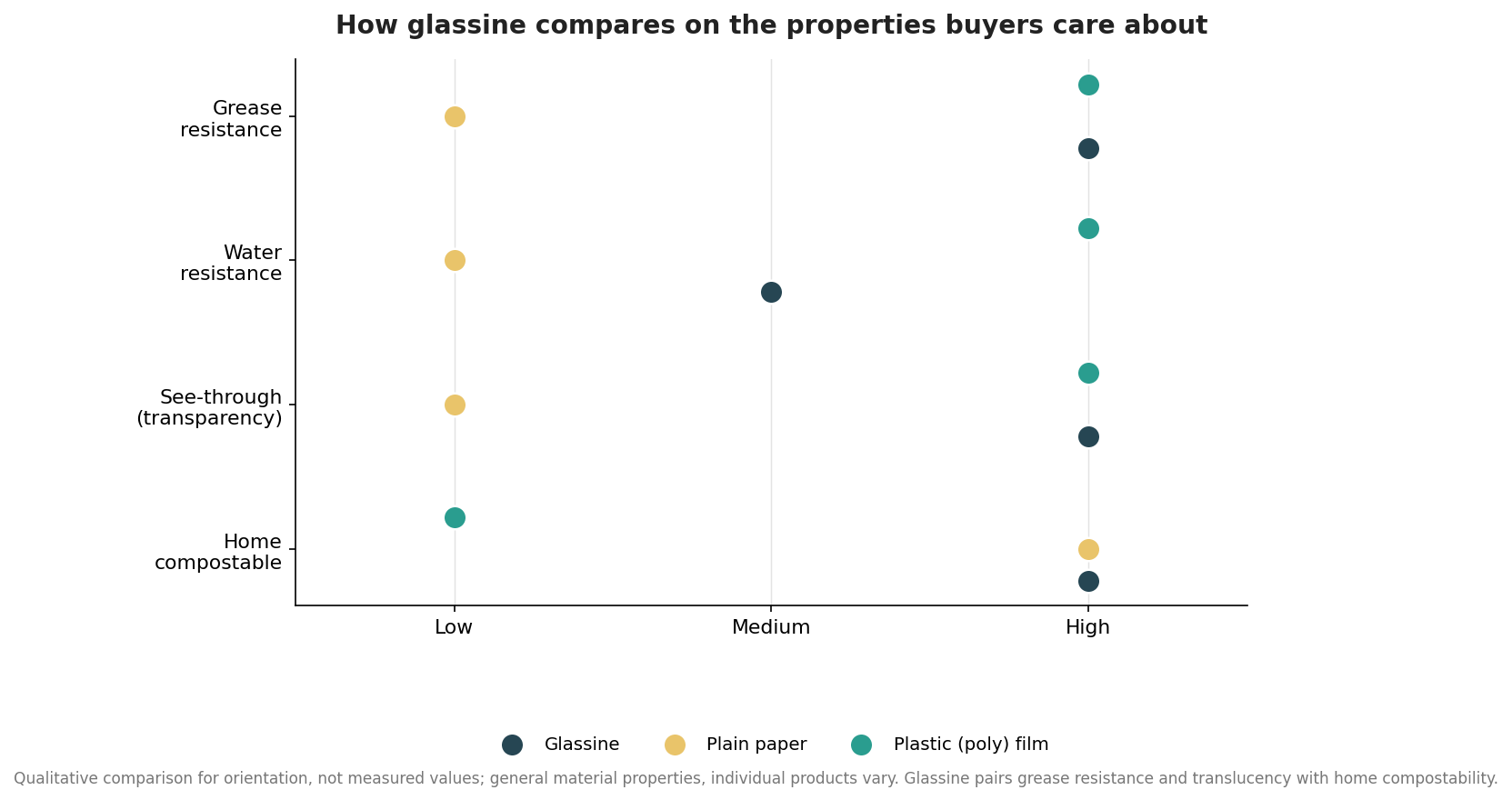
    Because standard glassine is just densified paper with nothing added, its disposal story is clean: it is recyclable curbside, biodegradable, and compostable both at home and in industrial facilities that accept packaging. It is also acid-free and pH neutral, generally in the 7 to 9 range, which is why the same material is trusted for archival storage of photographs and documents. Put those traits together and glassine occupies a genuinely useful middle ground. Plain paper is compostable too, but it offers little grease resistance and no transparency. Plastic film gives you water resistance and clarity, but it is not home compostable and increasingly runs into bag bans and customer disapproval. Glassine pairs real grease resistance and a translucent, premium look with an uncoated sheet that goes in the recycling or the compost.

    Dot plot comparing glassine, plain paper, and plastic film on grease resistance, water resistance, transparency, and home compostability using a low-medium-high scale
    A qualitative comparison: glassine combines grease resistance and translucency with home compostability.

    The practical way to use all of this is to match the material to what your product actually demands. If you are packaging a dry, greasy, or delicate item that benefits from a refined, see-through wrap and you care about a clean end-of-life, glassine is close to purpose-built, and choosing a food-grade stock in the medium weight range covers most bakery and boutique uses; confirm food-contact suitability with your supplier when the bag holds food. If your product is wet, needs a true moisture or oxygen seal, or has to survive a long time on a shelf, treat glassine as the wrong material rather than forcing a coating that would undo its best quality. Bought against its real strengths, glassine is one of the few packaging papers that looks the part and disposes cleanly without hiding a plastic or PFAS layer inside.

  • How Many Glassine Bags Should You Order? — Custom Glassine Bags

    Home › Blog › How Many Glassine Bags Should You Order?

    Ordering

    How Many Glassine Bags Should You Order?

    06/26/2026

    The most common question we get on a first order is not about size or color — it is how many to buy. Order too few and you are reordering within weeks at a worse per-unit price; order too many and you are storing a product that can yellow if it sits too long in direct light.

    The right number depends on what you are packaging for, so here is how we walk customers through it by use case.

    For a bakery or cafe

    Estimate your daily to-go and takeout volume, multiply by 90 days, and round up to your next price-tier quantity — ordering quarterly at a higher volume tier almost always beats reordering monthly at a lower one.

    For a retail or wholesale rollout

    Base the order on your current SKU velocity across all locations, plus a 15–20% buffer for a new launch, since first-run demand is hard to predict precisely.

    For a wedding or single event

    Order for your guest count plus a 5–10% buffer for assembly breakage and last-minute additions, and place the order a few weeks ahead of the event.

    Key takeawayWhen in doubt, round up to the next volume-pricing tier — the per-unit savings usually outweigh the cost of a slightly larger order.

    Ready to upgrade your packaging? Get a custom quote — free mockups in 24 hours. Learn more about how we work, or browse more guides.

    More posts

  • Flat vs. Gusseted vs. Window Glassine Bags: Which to Choose — Custom Glassine Bags

    Home › Blog › Flat vs. Gusseted vs. Window Glassine Bags: Which to Choose

    Buyer guides

    Flat vs. Gusseted vs. Window Glassine Bags: Which to Choose

    06/12/2026

    Most of our new customers arrive knowing they want a glassine bag and unsure which style fits their product. The three most common formats — flat, gusseted, and window — each solve a slightly different problem.

    Here is how they stack up against each other.

    Flat: lowest cost, simplest fill

    A flat bag is the least expensive per unit and the fastest to fill by hand or on a line, but it does not stand upright and can look flattened once a bulkier product is inside.

    Gusseted: shelf presence for bulkier items

    A gusseted bag’s block bottom lets it stand on its own, which matters for anything with real volume — a croissant, a stack of cookies — and doubles as its own counter display.

    Window: maximum clarity for gift-tier items

    A window bag adds a die-cut clear panel for true, undistorted visibility, at a small premium and a slightly longer production time — worth it for a best-selling or seasonal item where shelf appeal matters most.

    StyleStands uprightVisibilityRelative cost
    FlatNoGood (translucent)Lowest
    GussetedYesGood (translucent)Low–moderate
    WindowNo (typically)Best (true clarity)Moderate
    Key takeawayChoose flat for cost and speed, gusseted for shelf presence, and window for maximum product visibility on your best-selling items.

    Ready to upgrade your packaging? Get a custom quote — free mockups in 24 hours. Learn more about how we work, or browse more guides.

    More posts

  • Glassine Bags as Retail Packaging: The Overlooked Margin Booster — Custom Glassine Bags

    Home › Blog › Glassine Bags as Retail Packaging: The Overlooked Margin Booster

    Retail

    Glassine Bags as Retail Packaging: The Overlooked Margin Booster

    05/29/2026

    Most retailers default to a plain poly bag or a generic paper sack at checkout because it is cheap and easy. But at scale, the cost difference between a blank bag and a branded custom glassine bag is often just a few cents per unit — and what you get back in perceived value and repeat purchase can be worth far more than that gap.

    The math is worth walking through before your next packaging order.

    The impressions-per-dollar math

    A glassine bag is not single-use packaging that gets thrown away with the receipt. Customers reuse them to store small items, line a drawer, or wrap a gift — which means your logo stays in front of the customer well past the sale.

    Perceived value at the register

    Handing a customer a translucent, branded glassine bag instead of a plastic mailer changes how the entire purchase feels. It signals that the brand thought about the experience beyond the product itself — exactly the signal boutiques and specialty retailers are trying to send at every touchpoint.

    Where the margin comes from

    At standard volume pricing, a custom glassine bag typically lands in the same range as a decent branded poly bag, but customers do not keep a poly bag. The glassine bag’s reuse and photograph-ability effectively extend your marketing spend for free — a higher return on the packaging dollar you were already spending, not a lower unit cost.

    Key takeawayA branded glassine bag costs about the same as decent branded packaging but keeps working as free, reusable marketing long after the sale.

    Ready to upgrade your packaging? Get a custom quote — free mockups in 24 hours. Learn more about how we work, or browse more guides.

    More posts

  • Custom Glassine Bags for Bakeries & Confectionery Brands — Custom Glassine Bags

    Home › Blog › Custom Glassine Bags for Bakeries & Confectionery Brands

    Bakeries

    Custom Glassine Bags for Bakeries & Confectionery Brands

    05/15/2026

    A bakery’s packaging works overtime: it has to contain a warm, sometimes greasy product, survive a short trip home, and still look good enough to photograph. Plain kraft bags handle the first job and skip the other two.

    Custom glassine solves all three at once, which is why it has become the default upgrade for independent bakeries and confectionery brands trying to build a recognizable to-go presence.

    Grease resistance without the bulk

    Glassine’s natural grease and moisture resistance means a croissant or a butter cookie can sit in the bag through a full display case shift or a short delivery trip without the bag failing, and without adding the weight or cost of a laminated or foil-lined bag.

    Branding that photographs well

    Because the paper is translucent, the product itself becomes part of the packaging photo — a real advantage in an era where a customer’s social post is often a bakery’s best advertising.

    Consistency across a growing menu

    A single bag style in one or two sizes can cover most of a bakery’s counter needs, which keeps ordering simple even as the menu grows or a second location opens.

    Key takeawayGrease resistance, translucency, and a clean logo print are the three things a bakery’s bag has to get right — glassine is built to do all three.

    Ready to upgrade your packaging? Get a custom quote — free mockups in 24 hours. Learn more about how we work, or browse more guides.

    More posts

  • Glassine Bag Sizes Guide: Small, Medium, and Large Compared — Custom Glassine Bags

    Home › Blog › Glassine Bag Sizes Guide: Small, Medium, and Large Compared

    Buyer guides

    Glassine Bag Sizes Guide: Small, Medium, and Large Compared

    05/01/2026

    Picking a size before you have held a sample is the single most common source of a reorder. The good news is that glassine bag sizing follows the product it is meant to hold fairly predictably once you know the ranges.

    Use this table as a starting point, then send us the item’s dimensions and we’ll confirm the right fit with your mockup.

    Small vs. large, in practice

    Small formats (under 4 in) are built for findings, candy, and keepsakes; mid-size formats (4–8 in) cover most bakery and retail uses; large formats (8 in and up) are built for sandwiches, wraps, and bulkier bakery items.

    StyleTypical size rangeBest for
    Glassine Envelope2×2 in – 6×9 inJewelry findings, coins, stamps
    Glassine Favor Bag2×3 in – 4×6 inWedding favors, candy
    Flat Glassine Bag2×3 in – 10×12 inPastries, retail goods
    Window Glassine Bag3×4 in – 8×10 inChocolates, gift-tier retail
    Gusseted Glassine Bag3×2×6 in – 6×3.5×11 inBulkier baked goods
    Printed Deli Bag6×6 in – 10×12 inSandwiches, wraps, hand pies
    Key takeawaySend us the dimensions of what the bag needs to hold — we’ll recommend the right style and size in your free mockup.

    Ready to upgrade your packaging? Get a custom quote — free mockups in 24 hours. Learn more about how we work, or browse more guides.

    More posts

  • How to Order Custom Glassine Bags: A Step-by-Step Checklist — Custom Glassine Bags

    Home › Blog › How to Order Custom Glassine Bags: A Step-by-Step Checklist

    Ordering

    How to Order Custom Glassine Bags: A Step-by-Step Checklist

    04/17/2026

    Ordering custom packaging for the first time can feel more complicated than it needs to be. In practice, it comes down to four decisions and one approval step.

    Here is the checklist we walk every new customer through.

    1. Gather your artwork

    A vector logo file (AI, EPS, SVG, or PDF) prints the cleanest. If you only have a PNG or a photo of your logo, send it anyway — our designers rebuild it print-ready at no charge.

    2. Pick a style and size

    Match the bag to the product: flat for pastries and candy, gusseted for bulkier baked goods, an envelope for small parts or jewelry, deli-style for sandwiches, a window bag for gift-tier items, or a favor bag for events.

    3. Confirm quantity and color

    Our minimum is just 12 bags; per-unit pricing improves at higher volumes. Choose natural translucent, white, kraft, black, or a custom Pantone match.

    4. Approve your mockup

    We return a photo-real mockup within 24 hours. Revisions are free and unlimited until you approve — production only starts once the design is locked.

    Key takeawayFour decisions — artwork, style, size, and color — are all we need to start your free mockup.

    Ready to upgrade your packaging? Get a custom quote — free mockups in 24 hours. Learn more about how we work, or browse more guides.

    More posts