Glassine spends most of its life as bakery and boutique packaging, but it has a second career that predates the gift shop: protecting things people cannot afford to damage. Photographers, artists, framers, stamp and print collectors, and museum staff all reach for glassine to interleave, wrap, and shield delicate materials. If you are considering glassine bags or sheets for archival use, it helps to know exactly why conservators like it, the specific jobs it does well, and the honest limits that separate it from true permanent storage materials. Used for the right task, glassine is inexpensive and excellent. Used for the wrong one, it creates a false sense of security.
Why archivists reach for glassine
Glassine’s value in storage comes from a short list of physical traits. It is smooth and non-abrasive, so it will not scuff a photograph’s emulsion or scrape a graphite or pastel surface, and because it is dense and hard-surfaced it resists offsetting, the transfer of media onto the interleaving sheet. It is typically acid-free and pH neutral, usually measuring right around 7.0, which means it will not drive the yellowing and embrittlement that acidic papers cause in whatever they touch. It is grease- and moisture-resistant at the surface, useful for interleaving oil-based media or protecting against fingerprints and light spills. And it is translucent, letting you identify what is inside a wrapper or sleeve without unwrapping it. The profile below shows where those strengths sit, and where the one real weakness is.
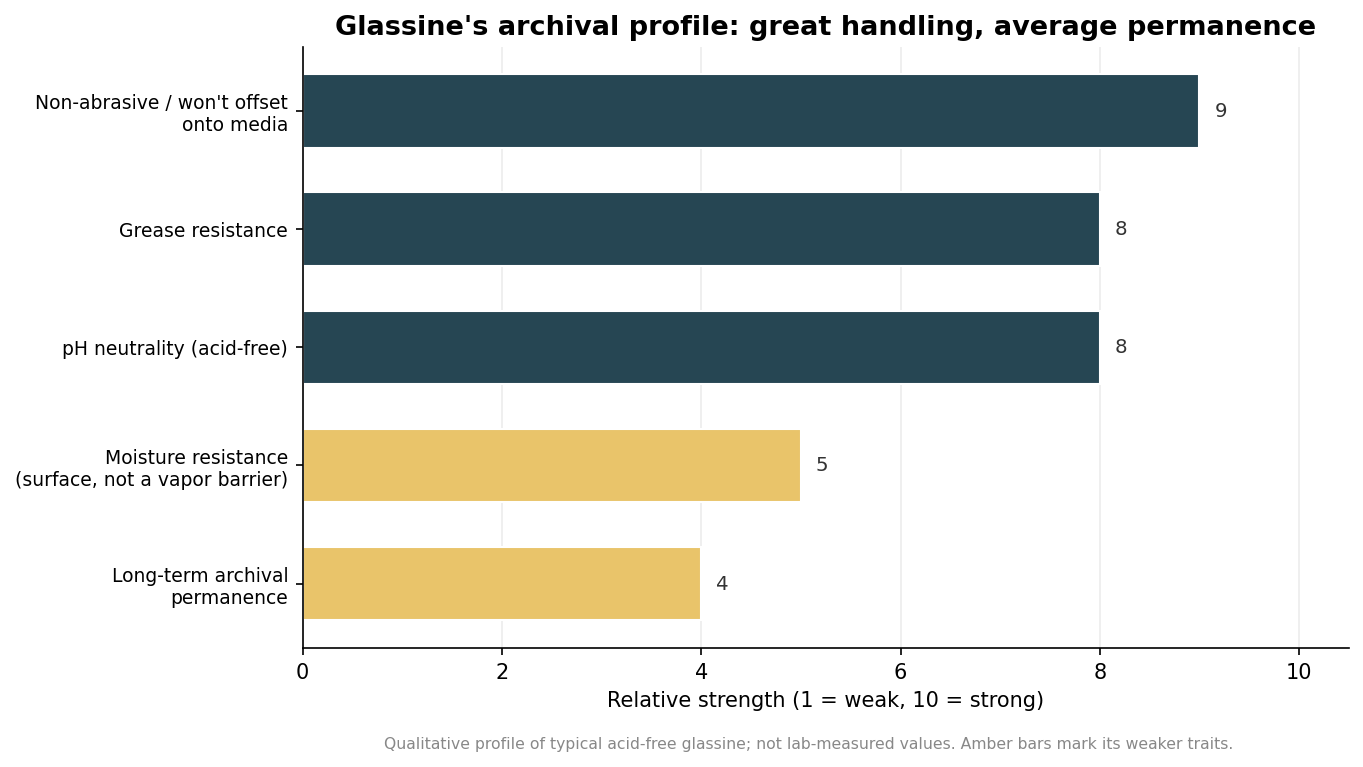
The takeaway from that profile is that glassine is outstanding at handling and short-term protection and only average at permanence. That is not a flaw so much as a definition of what the material is for, and it maps cleanly onto which jobs it should and should not do.
The jobs glassine does best
Interleaving artwork is glassine’s signature use. Slipping a sheet between stacked prints, watercolors, pastels, and charcoal drawings keeps surfaces from rubbing against one another in a portfolio or flat file, and its non-offsetting surface makes it safer for friable media than many alternatives. Protecting photographs is a close second; unbuffered neutral glassine is a common choice for interleaving prints and negatives because it is smooth and chemically calm against emulsions. Stamps, coins, pressed botanicals, and paper ephemera have been stored in glassine envelopes for generations, and it remains the default in philately for exactly that reason. And for shipping and short-term transit, wrapping a framed piece or an original print in glassine adds a clean grease- and scuff-resistant layer that costs little and adds almost no weight. In all of these, glassine is doing the job of a gentle, chemically safe buffer for weeks, months, or a few years.
What glassine is not
Being honest about the limits is what keeps a collection safe. First, glassine is not a moisture or vapor barrier. It resists surface grease and brief contact with liquid, but it will absorb ambient humidity, and in damp conditions it can cockle, and in extreme cases stick to whatever it wraps, so it is no substitute for climate control. Second, glassine is not a permanent archival material in the way inert polyester film or high-quality buffered board is. Conservation references note that glassine can become acidic and brittle as it ages, which means the neutral pH you start with is not guaranteed to hold across decades. For truly long-term storage of valuable items, conservators favor inert polyester sleeves such as Mylar or Melinex, or acid-free tissue, and often treat glassine as a working, replaceable interleaf rather than a permanent enclosure.
There is also a nuance worth understanding: buffered versus unbuffered. Buffered papers carry an alkaline reserve that helps neutralize acids over time and are generally preferred for most paper artifacts, while unbuffered neutral materials are often recommended for photographs and certain color media that can be harmed by alkalinity. Most glassine is unbuffered and neutral, which makes it a natural fit for photographic interleaving but not the automatic best choice for every paper object. The comparison below places glassine against the two materials it is most often weighed against.
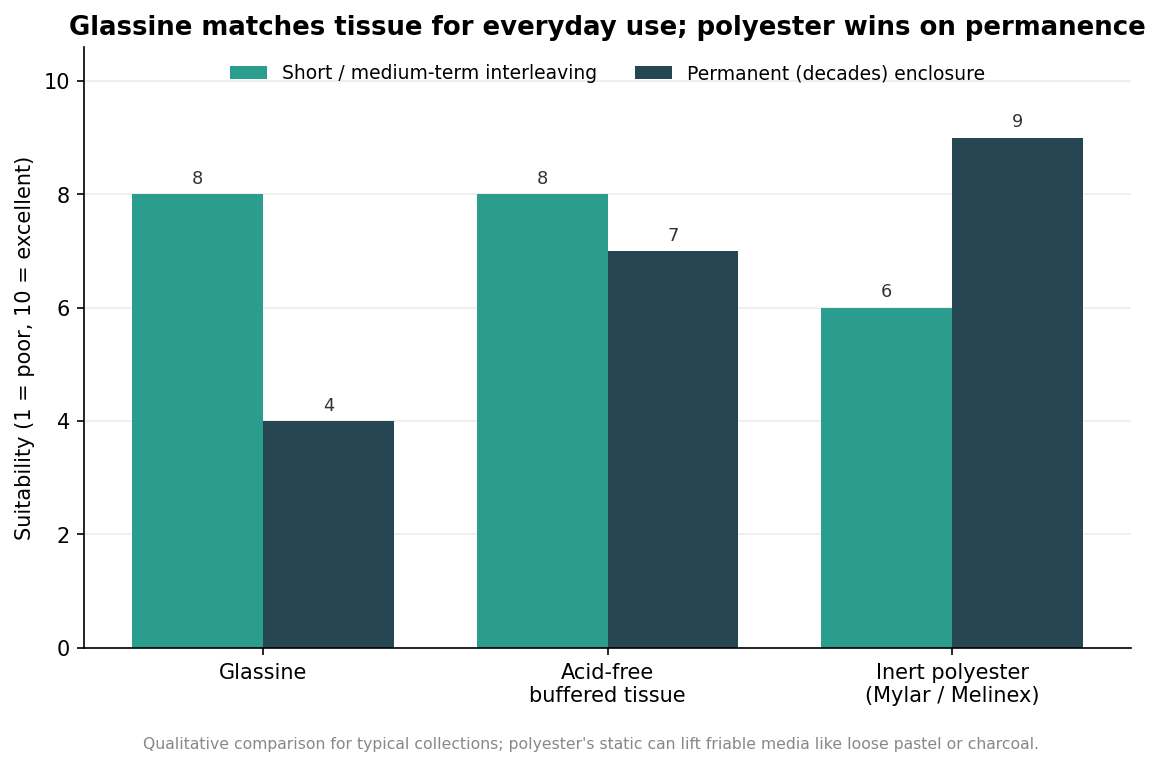
The pattern is clear: glassine and acid-free tissue are both strong for the everyday interleaving that most people actually need, while inert polyester pulls ahead specifically for permanent, decades-long enclosure of high-value pieces. One caution on polyester, though, is that its static charge can lift friable media like loose pastel or charcoal, so it is not a drop-in replacement for glassine in every case. The right material depends on the object and the time horizon, not on which one sounds the most archival.
How to choose glassine for archival use
If glassine fits your task, a few specifics make the difference. Confirm the paper is acid-free and neutral pH and, for photographs, that it is unbuffered; a supplier should be able to state both plainly. Choose a weight that matches the handling: lighter glassine around the 25 to 30 gsm range drapes well for interleaving and wrapping, while heavier stock holds up better as a bag or envelope that will be opened and closed repeatedly. Match the format to the workflow, using flat interleaving sheets for portfolios and flat files, and glassine bags or envelopes for small collectible items that need containment. Size the enclosure so the item sits without forcing or excessive slack. If you are printing a logo on glassine bags for a shop, remember that the same smooth, low-absorbency surface that protects artwork also makes ink adhesion trickier, so keep archival-contact designs minimal and confirm the ink is suitable for direct contact with what you store. Chosen with those points in mind, glassine remains one of the most cost-effective protective materials available, provided you use it for the handling and medium-term jobs it was built for and step up to polyester or acid-free tissue when permanence is the priority.