Most glassine buying guides talk about dimensions first. The spec that actually decides whether a bag protects your product is its basis weight — the grams per square meter (gsm) of the paper itself. A bag that is the right size but the wrong weight either wastes money or lets grease bleed through, and there is no way to fix that after the print run. This walkthrough covers how glassine weight is measured, the three weight bands you will actually be quoted, and how to match a grade to what you are packing.
What “glassine weight” actually measures
Glassine is a wood-pulp paper that gets its glassy, translucent surface from supercalendering — the dried web is run through heated, high-pressure rollers again and again until the fibers lie flat and the sheet becomes dense and closed. The result is paper that is close to twice as dense as ordinary uncoated stock, often above 1.0 g/cm³, with almost no porosity. That density is what gives glassine its grease resistance without any wax or plastic coating.
Basis weight is quoted in gsm and, for glassine, commonly runs from about 18 gsm at the lightest to roughly 90 gsm at the heaviest. Two sheets can share the same footprint and feel completely different in the hand because of this number. Higher gsm means a stiffer, more opaque, more protective bag; lower gsm means a lighter, more see-through, more economical one. Everything below is about spending that weight where it earns its keep.
The three weight bands and what each is for
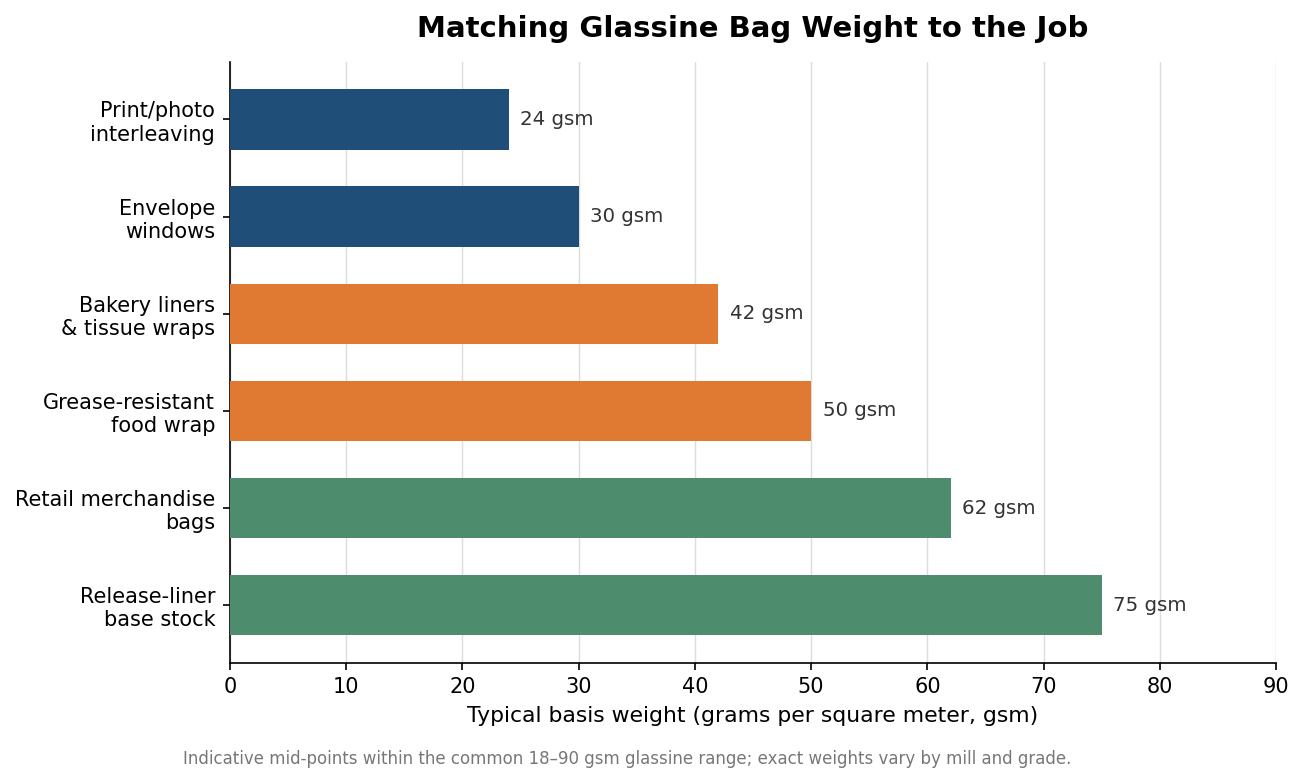
Light grades, roughly 18–30 gsm. This is interleaving and window territory. Slip sheets between prints and photographs, tissue-style garment wraps, and the little transparent panels in envelopes all live here. The paper is prized for being thin, smooth, non-abrasive, and static-free rather than for being a heavy barrier.
Mid grades, roughly 40–60 gsm. This is the workhorse range for food and retail. A sheet around 40 gsm already resists butter and oil migration well enough for pastry interleaving and general food wrapping, which is why bakery liners cluster here. Move toward 50–60 gsm when you want a bag that holds its shape on a shelf and takes a clean print.
Heavy grades, 60 gsm and up. Once you pass 60 gsm you are into durable merchandise bags and the base stock used for release liners. These feel substantial, block more light, and stand up to repeated handling. You pay for the extra fiber, so reserve this band for products that need the structure.
What the grease and moisture barrier does — and does not do
The barrier in glassine is structural, not a coating. Because supercalendering closes the pore network, oils and greases cannot wick through the way they do in ordinary paper, and water-vapor transmission sits well below that of plain uncoated paper of the same weight. For interleaving chocolates, wrapping a scone, or protecting a print from fingerprints, that is exactly the behavior you want.
It is still paper, though. Glassine slows moisture; it does not stop it. Prolonged contact with liquid water, or full submersion, will eventually soak the sheet. If your product is wet, oily to the point of pooling, or needs a true moisture seal for long-term storage, glassine is the wrong barrier and you should look at a coated or laminated structure instead — accepting that you trade away the clean recyclability described below.
Food safety and archival use
Two properties make glassine popular well beyond packaging. First, it is typically acid-free with a neutral pH in the 7–9 range, which is why archivists, photographers, and stamp collectors use it to interleave and store material without the yellowing and embrittlement that acidic papers cause over time. Second, food-grade glassine is made for direct contact with dry and greasy foods.
If a bag will touch food, ask the supplier specifically for a food-contact-grade sheet and for the documentation behind it, rather than assuming any glassine qualifies. “Glassine” describes how the paper is finished, not a guarantee that a particular roll was manufactured and certified for food use. The distinction matters at reorder time, so get it in writing on the first order.
End of life: recycling and composting
The reason many brands move to glassine is what happens after the customer is done with it. Uncoated glassine is fiber and nothing else, so it recycles in the standard curbside paper stream and is both home- and industrially compostable, breaking down naturally rather than persisting. That end-of-life story is only intact while the paper stays uncoated — add a plastic laminate or a non-compostable ink and you can forfeit both the recyclability and the compostability.
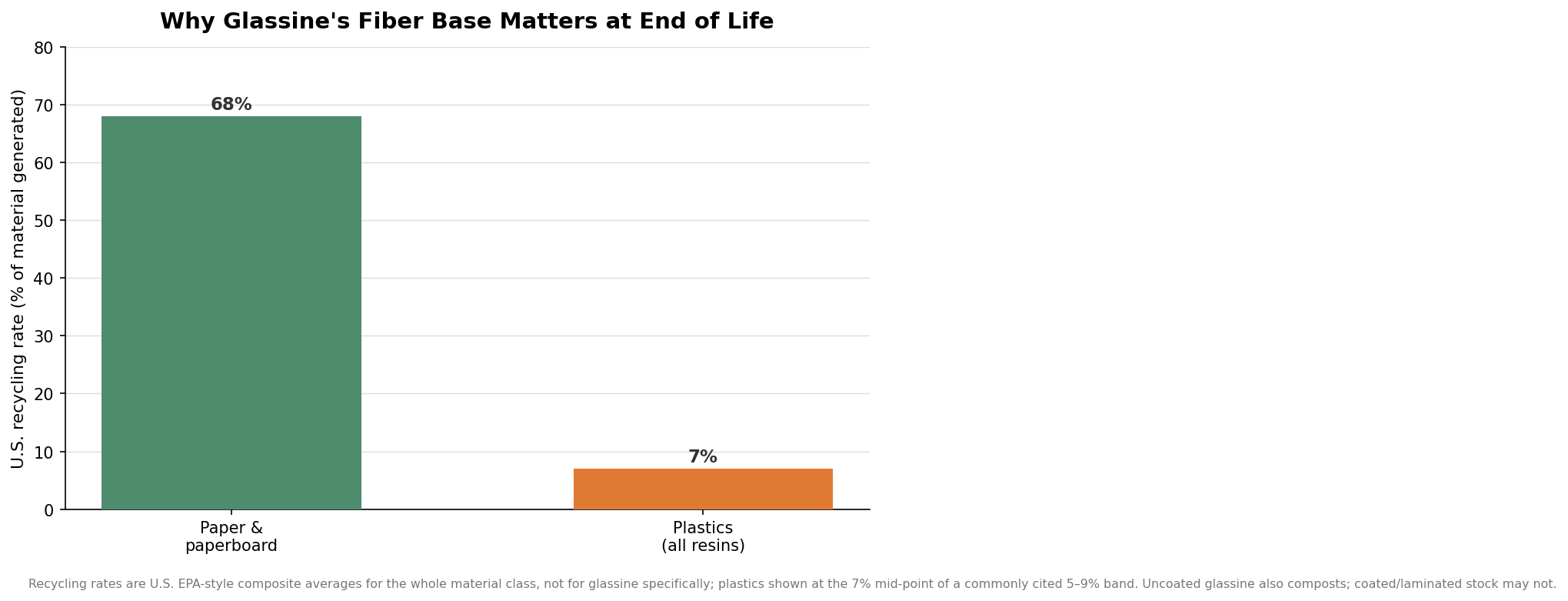
The contrast with plastic film is the selling point worth putting on your packaging copy. Paper and paperboard are recovered in the United States at roughly 68% of what is generated, while plastics as a class sit in the single digits. Those are broad material-class averages rather than glassine-specific figures, but they explain why a fiber-based bag reads as the more responsible choice to a sustainability-minded buyer.
Specifying it in one line
Put the weight first. Decide what the bag has to survive — a slip sheet, a greasy pastry, a shelf, a shipping journey — pick the band that matches, then confirm size, window, and print. For anything touching food, add “food-contact grade, documentation required” to the spec, and if you are marketing the eco angle, keep the sheet uncoated and confirm the inks are compost-compatible. Get those points on the quote and the bag will do its job on the first run instead of the third.