Glassine gets specified for its looks: that smooth, semi-transparent sheet that makes a pastry or a print look considered rather than merely wrapped. But the reason it works as packaging has almost nothing to do with appearance and everything to do with how the paper is made. Understanding what glassine actually is tells you where it is the right material, where it will let you down, and why it is quietly well suited to a moment when buyers want grease resistance without the coatings regulators are now restricting.
What glassine is and how it is made
Glassine starts as ordinary wood pulp with the lignin removed, leaving clean cellulose fibers and, importantly, no coatings or additives. What makes it glassine is a finishing step called supercalendering: the dried paper is passed repeatedly through heated, high-pressure rollers that press the sheet hard enough to align the fibers and collapse the air gaps between them. The result is a dense, smooth, glossy paper, often above 1.0 gram per cubic centimeter in density, that reads as semi-transparent to translucent because light passes through the tightly packed fibers rather than scattering off a rough surface. That single mechanical process is the source of nearly every property that follows.
Grease resistance without a plastic or PFAS coating
The most useful thing about glassine is that its grease resistance is structural, not chemical. When the supercalenders collapse the air channels inside the sheet, they remove the easy paths that oil would otherwise wick through, so the paper resists grease on its own without a fluorochemical or plastic barrier applied on top. This matters more than it used to. Across foodservice packaging, the fluorinated treatments known as PFAS have been the traditional way to make paper hold back oil, and a wave of state laws is now banning intentionally added PFAS in food packaging. An uncoated glassine bag sidesteps that problem by design, because there is no added barrier chemistry to regulate in the first place. For a bakery or confectioner choosing packaging, that is a real advantage rather than a marketing line.
What it resists, and what it does not
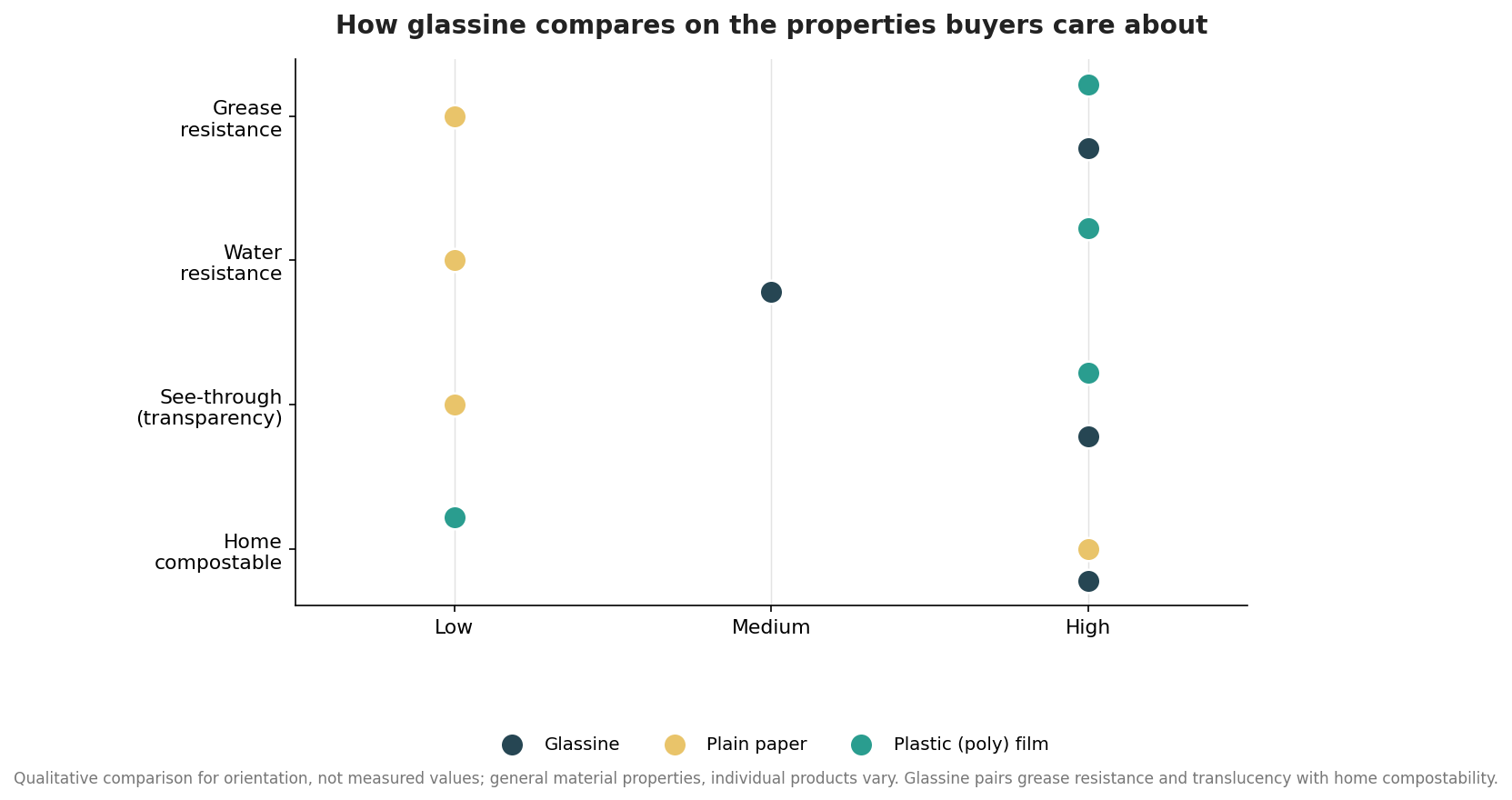
It is just as important to know glassine’s limits, because the same density that stops grease does not make the paper waterproof. Glassine offers higher resistance to moisture than standard paper and shrugs off ambient humidity and stray droplets, which is why it keeps a cookie crisp on a shelf far better than plain kraft. It is still paper, though, and it will not survive submersion or prolonged contact with a wet product; uncoated glassine’s moisture resistance is best described as moderate, not a seal. It is also not an oxygen or aroma barrier, so it is made for near-term presentation and short-shelf-life items rather than long-term preservation. Manufacturers can add functional coatings to push moisture resistance higher, but that trade cuts against glassine’s headline strength, because coatings compromise its recyclability. If your product genuinely needs a moisture seal, glassine is the wrong tool, or at least not the whole answer.
Weights and grades: matching gsm to the job
Glassine is sold in grades defined by basis weight in grams per square meter, and picking the right one is mostly about balancing translucency against toughness. Light grades, roughly 18 to 30 gsm, are the most see-through and the most economical, which suits interleaving between prints, tissue-style wraps, and the little windows in envelopes. Medium grades, about 40 to 60 gsm, are the workhorse range for food wrapping, bakery liners, and most printed bags, where you want the grease resistance and a sheet substantial enough to handle and to print on cleanly. Heavy grades above 60 gsm trade some translucency for durability and show up as release-liner bases and demanding wraps.
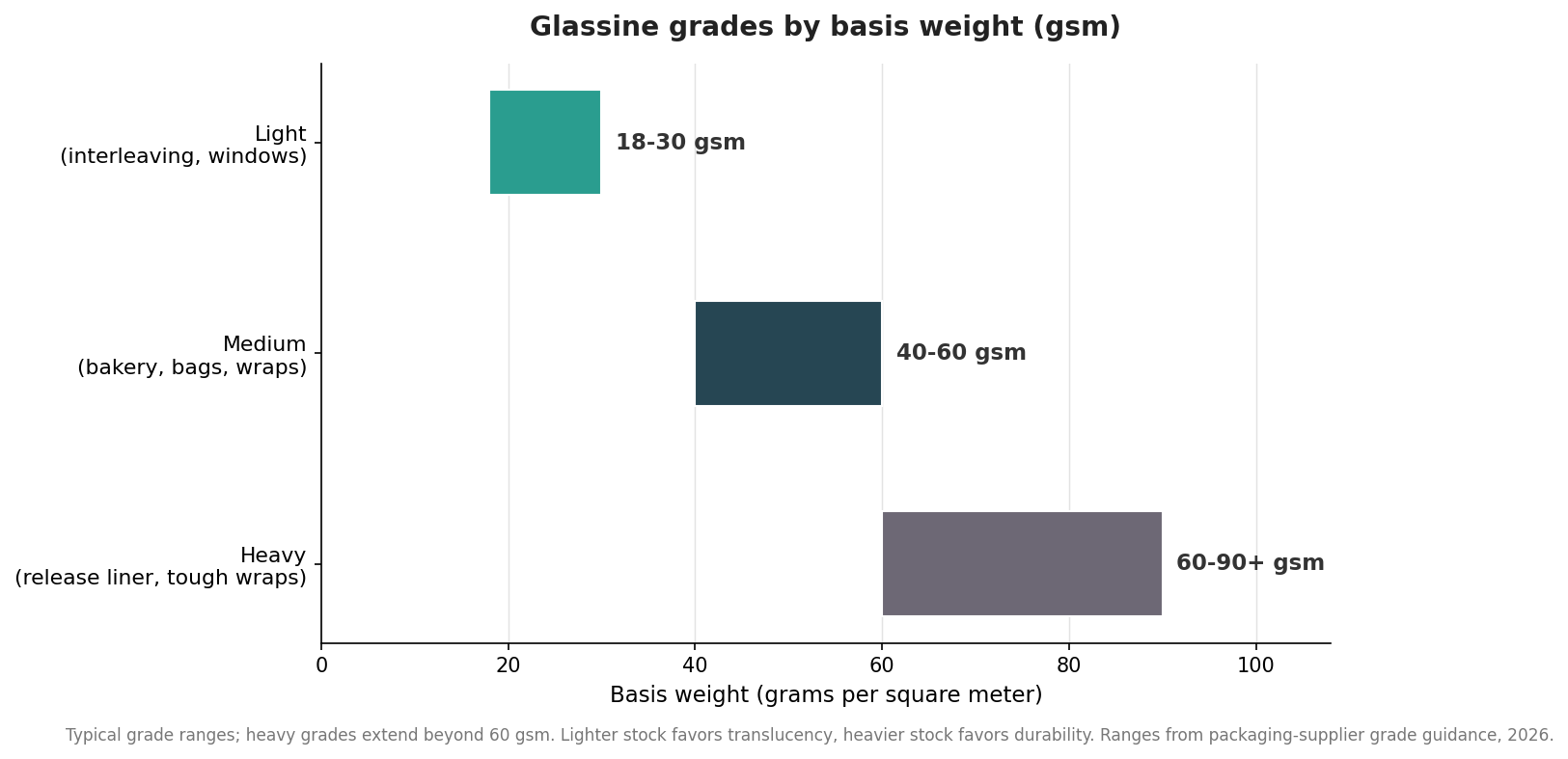
For a custom bag, that usually points to the medium range. Go too light and the bag feels flimsy and prints less crisply; go too heavy and you lose the translucency that made you choose glassine in the first place and pay for material you do not need. If you are wrapping a delicate print or layering favors, the light grade is deliberate; if you are bagging a scone, medium earns its keep.
End of life, and how it compares
Because standard glassine is just densified paper with nothing added, its disposal story is clean: it is recyclable curbside, biodegradable, and compostable both at home and in industrial facilities that accept packaging. It is also acid-free and pH neutral, generally in the 7 to 9 range, which is why the same material is trusted for archival storage of photographs and documents. Put those traits together and glassine occupies a genuinely useful middle ground. Plain paper is compostable too, but it offers little grease resistance and no transparency. Plastic film gives you water resistance and clarity, but it is not home compostable and increasingly runs into bag bans and customer disapproval. Glassine pairs real grease resistance and a translucent, premium look with an uncoated sheet that goes in the recycling or the compost.
The practical way to use all of this is to match the material to what your product actually demands. If you are packaging a dry, greasy, or delicate item that benefits from a refined, see-through wrap and you care about a clean end-of-life, glassine is close to purpose-built, and choosing a food-grade stock in the medium weight range covers most bakery and boutique uses; confirm food-contact suitability with your supplier when the bag holds food. If your product is wet, needs a true moisture or oxygen seal, or has to survive a long time on a shelf, treat glassine as the wrong material rather than forcing a coating that would undo its best quality. Bought against its real strengths, glassine is one of the few packaging papers that looks the part and disposes cleanly without hiding a plastic or PFAS layer inside.